Leaving the Factory, 2026 15'51'' HD
Leaving the Factory
A collaborative film and research project by Johanna Billing, Tor Lindstrand, Erik Wingquist and Anja Thedenius
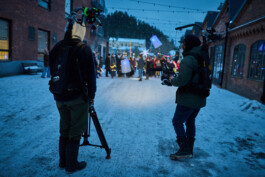
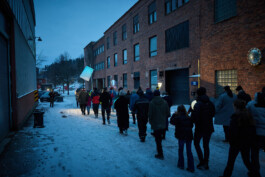
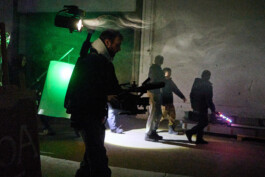
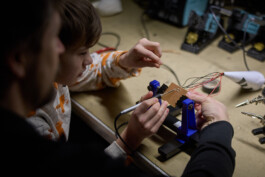
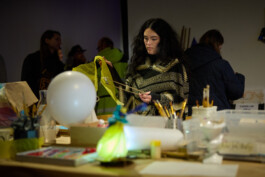
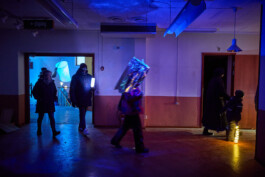
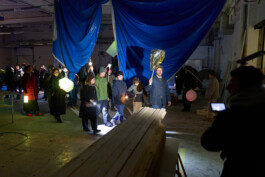
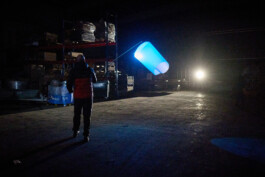
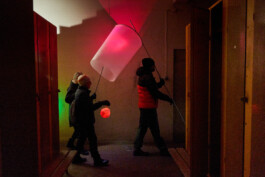
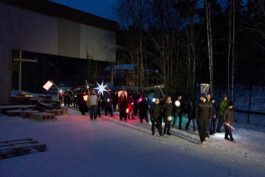
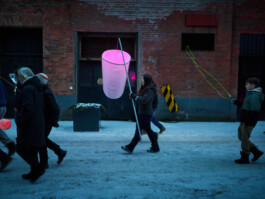
In the opening of this 16-minute film sequence, we see a diverse crowd of people: four-year-olds, teenagers, adults, and retirees. They are bundled up in thick puffer jackets and lined over-trousers, equipped with headlamps and flashlights. Some have LED strips sewn into their clothing and headgear. Together, they brave the sub-zero temperatures of a January evening, carrying handcrafted lanterns in imaginative, abstract shapes made from materials like plastic foam, paper, recycled metallic emergency blankets, floral sticks, and balloons. The DIY LED technology creates a glow that shifts in color along the route. The group moves in a collective, choreographed flow through the walkways and buildings of the industrial site, mirroring the rushing culverted stream that runs beneath the ground and under their feet.
Norrahammar’s Bruk is a historic industrial site south of Jönköping, originally known for its foundry work and machinery manufacturing. After closing in 1991, the mill stood vacant for a long time, but today it houses a mix of small-scale production, crafts, art, and local community organizations. The area is a central part of the region's industrial heritage and is facing a historic transformation as Jönköping Municipality develops new plans for the site. This film is part of the artistic research project För allmänt bruk: Norrahammar, initiated by ArkDes in collaboration with Jönköping Municipality.
While working with the industrial site—particularly after studying materials from Folkrörelsearkivet (the Labor Movement Archives in Norrahammar)—it became clear how much movement has been a part of this place for generations. There is an underlying rhythm to the location found in the flowing waters of the Taberg stream, in cable cars, conveyor belts, machine halls, and along production lines; material rhythms intertwined with the rhythm of the working man.The very first film recording, the Lumière brothers' La Sortie de l'Usine Lumière à Lyon (1895), shows workers leaving their jobs through the factory gates. The purpose of that film was to demonstrate how photography could capture motion. In his film Arbeiter Verlassen die Fabrik (1995), German artist Harun Farocki traced this visual motif through film history, exposing a paradox. Although the very first movie camera was pointed directly at a factory, cinema as a medium has systematically pushed away and avoided factory work as a subject. Farocki argues that feature films generally begin exactly at the moment and place where wage labor ends. Industrial production is relegated to the margins of film history. Work is conspicuous by its absence, and on the few occasions it is depicted, it often serves merely as a backdrop for other narrative conflicts.
The industrial heritage of Norrahammar is a story of heavy, physical, and dirty labor—a tangible and bodily reality documented in the 1960s and 1970s by the Swedish photographer Jean Hermanson (1938–2012). Raised in a foundry family in Norrahammar, Hermanson worked at the mill himself and was intimately familiar with the atmosphere of industrial environments. During a time when Swedish society was undergoing rapid change and the "Swedish Model" was under pressure, Hermanson undertook several reportage trips across the Swedish industrial landscape. Hermanson’s photographic method was empathetic, present, and patient. He actively and consciously departed from the prevailing media and industrial convention of viewing workers as an anonymous, faceless collective "workforce" or as cogs in a machine. Through his portrait studies, he instead gave them individual identities, a public face, and a voice, creating a visual historiography that transcended the boundaries of photojournalism and established a unique form of humanistic documentary photography. These images depict a time, a class, and a society that, in today's service-based economy, has largely been rendered invisible or intentionally suppressed.
In Leaving the Factory (2026), the camera once again moves through the buildings of Norrahammars Bruk in a long, sweeping shot. Some participants may be the very individuals Hermanson captured on this site over 60 years ago. But there are also new visitors—children and young people who have never been here before. Now, the machines have fallen silent and the workers have vanished. The documentary focus shifts from the movement of the working body to the residual memory of the rooms. The process of studying building permits and blueprints to understand how the structures were successively rebuilt, expanded, and reorganized becomes, through the camera’s movement, an opportunity to read the spaces as part of a continuous transformation.
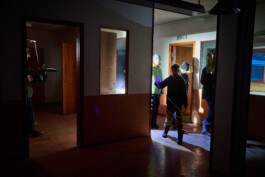
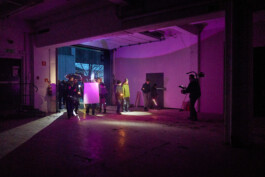
The architecture carries visible layers and memories from different eras up to the present day. In the film, the lantern parade makes its way through empty, darkened halls, past peeling veneer doors, and through abandoned, tiled locker rooms. The light sources momentarily illuminate the worn changing rooms with their long sinks and shower stalls, catching a glimpse of forgotten clothing before leaving the rooms in darkness once more.
The film's score is composed by the Second Hand Orchestra and consists of several instrumental and analog-recorded improvisations. Through a blend of instruments such as oboe, nyckelharpa (keyed fiddle), cello, and toy instruments, it enhances the film's inherent sense of searching. Much like the eclectic and ephemeral nature of the lanterns, the music shifts its character for each new building and room.
The project was carried out in collaboration with the association Makers Jönköping and Tabergsådalens Kulturhus. It was produced by Jönköping Municipality in collaboration with ArkDes as part of the practice-based research project För allmänt bruk: Norrahammar.


Leaving the Factory, 2026, 15'51''
A film by team TEJA (Tor Lindstrand, Erik Wingqvist, Johanna Billing, and Anja Thedenius) with participants from Norrahammar. Cinematography by Joshua Aylett and Francisco Imoda, Editing: Johanna Billing, Sound Mix: Henrik Sunbring (Helter Skelter studio), Colorist: Jonatan Qvist, Still Photography: Patrik Svedberg, Music: The Second Hand Orchestra, still photograpy: Patrik Svedberg
The project was carried out in collaboration with the association Makers Jönköping and Tabergsådalens Kulturhus. It was produced by Jönköping Municipality in collaboration with ArkDes as part of the practice-based research project För allmänt bruk: Norrahammar
Works